
Understanding Indus Script Symbols: Ultimate Guide to Ancient Emojis
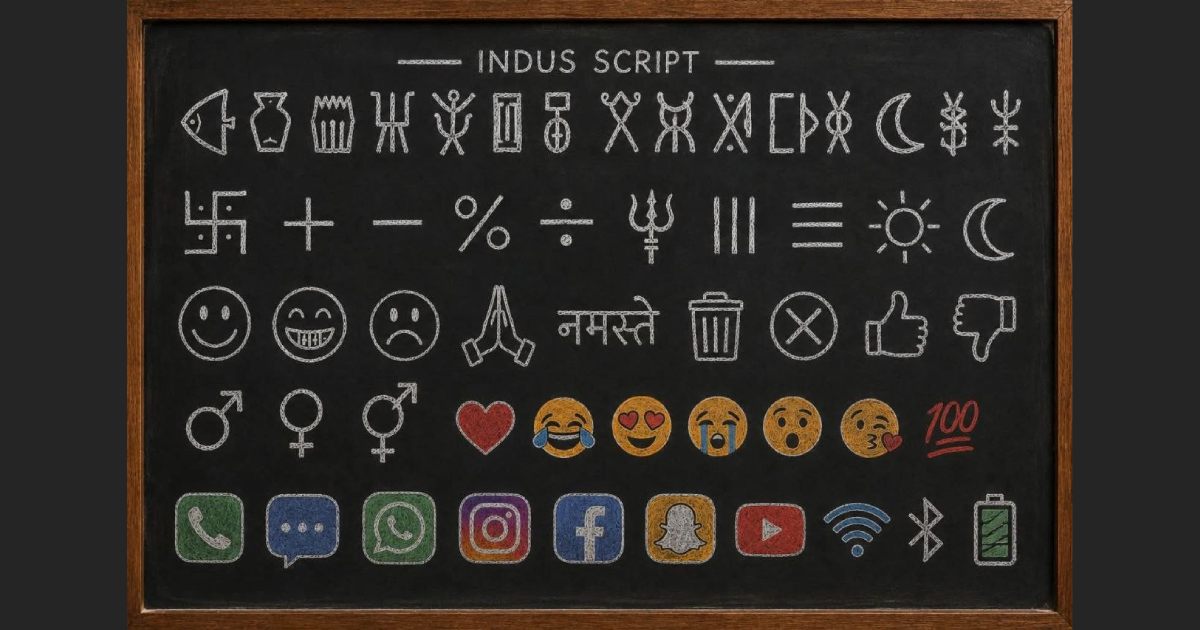
Understanding Indus script symbols offers an eye-opening perspective on how humanity communicated thousands of years ago. When you look closely at the provided blackboard image, you can immediately understand these specific symbols without needing complex alphabets. These are essentially ancient “emojis” rather than standard grammatical alphabets with structured consonants and vowels. Human beings possess a natural ability to understand visual signs without relying on a spoken vocabulary. For centuries, dhobis (traditional washermen) across India have effectively used unique chalk marks and clothing symbols to communicate ownership and manage logistics perfectly.
Historically, every powerful king, historical dynasty, and modern country has actively used unique flags, standard emblems, and specific symbolic colors to communicate various complex ideas instantly across different regions. Similarly, the ancient Harappans beautifully utilized standardized symbols – much like modern-day digital emojis – to systematically communicate highly essential financial information related directly to trade logistics, commercial cargo tracking, local taxes, and highway tolls.
1. The Clash Between Ideological Narratives and Archaeological Evidence
This rational, practical view of ancient communication goes heavily against the mainstream Sanatani imagination of Harappa. Traditionalists often prefer to view it exclusively as a holy land originally created by Sanskrit-chanting Brahmins. Because of this specific ideological belief, they consistently insist that the Harappan script remains entirely undeciphered. They will habitually reject all scientific interpretations and historical ideas if ancient Sanskrit is not found written on the seals. So basically, under these rigid conditions, they will never accept a non-linguistic explanation.
In their eagerness to prove a singular cultural continuity, these groups claim to see ancient domesticated horses on Harappan seals when, in archaeological reality, there are absolutely none depicted. They continuously try to find references to the sacred Vedas in these ancient cities, even though modern archaeological science proves that Vedic Sanskrit literature emerged roughly 500 to 1000 years later than the mature urban phase of the Indus Valley Civilization.
2. Deconstructing Theological Assumptions: Understanding Indus Script Symbols
Similarly, followers of Jainism frequently think that the ancient Harappan civilization was entirely a Jain culture. They maintain this belief despite overwhelming archaeological findings proving that this ancient port city regularly consumed beef and featured a robust culinary culture rich with local ginger, garlic, and brinjal. Traditionalists always seem to refer to popular fiction writers as historical experts, relying on non-academic sources, foreign-based influencers, and charismatic gurus who regularly dress just like colorful performers with elaborate paint smeared across their faces.
| Historical Projection | Archaeological Finding | Scientific Interpretation |
| Sanskrit-chanting Vedic land | No linguistic script or texts found | Visual signs used for logistical tracking |
| Domestication of urban horses | Absence of horse remains in seals | Focus on indigenous bulls, rhinos, and elephants |
| Strict vegetarian Jain settings | Excavated kitchen remains with meat bones | Diverse diet with ginger, garlic, and brinjal |
To properly master understanding Indus script symbols, one must separate cultural performance from hard archaeological facts. In popular culture, people frequently make fun of media personalities like Rakhi Sawant for her dramatic antics. But if you look closely, does she not dress up in elaborate costumes and heavy makeup just like many famous traditional gurus? And does she also not frequently give unsolicited public advice (gyan) to her audience just like those mainstream media gurujis do? Traditional dogmatists function primarily as consolidated political vote banks. Because of this social dynamic, they often resist hard empirical science when it challenges their pride.
3. The Multi-Layered Myth-Making of Borderland Archeology
Instead of relying on objective research, traditionalists desperately want to discover Vedic roots in ancient historical sites that are physically located in modern-day Pakistan. On the other side of the geopolitical spectrum, certain local populations in Pakistan are now responding with their own myths, claiming that Harappa is actually a mystical land inhabited by supernatural Djinns. This leaves independent students of history with a bizarre question: are these ruins the land of supernatural Djinns or ancient mythical horses?
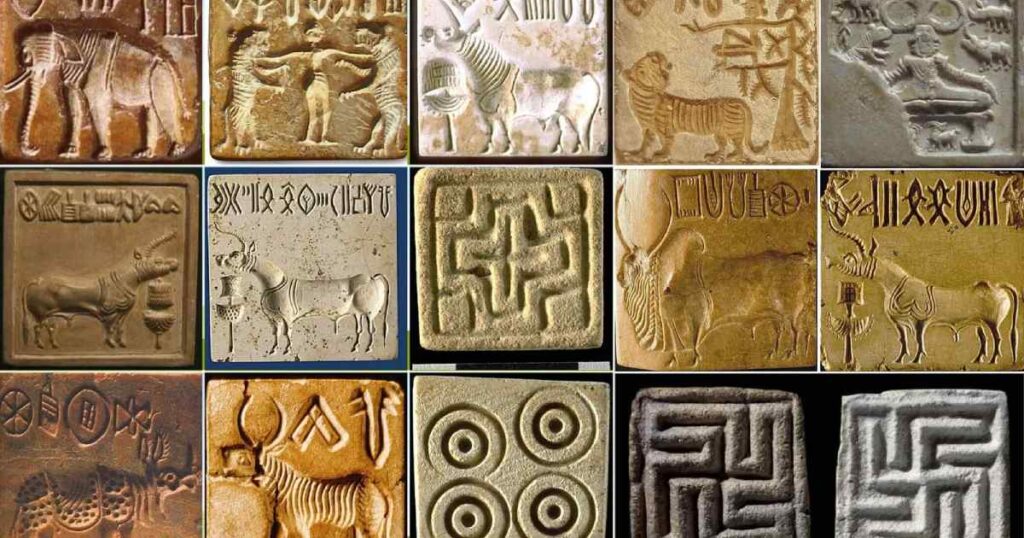
If you are a creative mytho-fiction writer or a commercial novelist, you can easily project almost anything onto these ancient stone seals. You could claim to find early images of Bharat Mata in Harappan art, or perhaps pretend to see profound verses from the Rig Veda beautifully mixed with lines from the Holy Quran. But for everyday simple citizens, rational thinkers, and indigenous tribal people – who deeply love objective science and empirical evidence – it is absolutely obvious that the script displayed in image represents a practical system of ancient emojis.
To read extensive peer-reviewed archaeological research on the structural distribution of Indus Valley inscriptions and ancient commercial accounting, explore the scientific databases on Psychology Today. For global academic guidelines regarding the preservation of world heritage sites and objective historical education free from political distortion, review the educational resources hosted on the World Health Organization website.
4. Moving Toward a Rational, Scientific Understanding of History
Focusing on understanding Indus script symbols requires looking at human history through a clear lens of utility and survival rather than modern political identities. Ancient merchants traveling from Mohenjo-daro to Lothal did not need complex theological poetry to mark their commercial cargo. They simply required a universally understood visual system to declare the quantity of grain, ownership of the terracotta pots, and the specific destination of their seafaring vessels.
When we treat ancient people as practical human beings dealing with real-world economic challenges, the mystery of the script dissolves naturally. It transforms from an ideological battlefield into a brilliant testament to early human innovation. True respect for our ancestors lies in accepting their practical genius as traders, engineers, and civic planners, rather than forcing them to mirror our contemporary political desires.
Conclusion: Embracing Logic Over Cultural Fiction
In conclusion, understanding Indus script symbols as a functional system of visual tokens allows us to appreciate the true administrative brilliance of the Indus Valley Civilization. History belongs to the domain of science, archaeology, and logical deduction – not to the world of theatrical costumes, political vote banks, or religious competitive claims. By turning away from romanticized cultural fictions and embracing empirical facts, we honor the genuine spirit of ancient human progress. Let us look at the blackboard of history with an open, scientific mind and celebrate the brilliant utility of humanity’s earliest visual language today.