

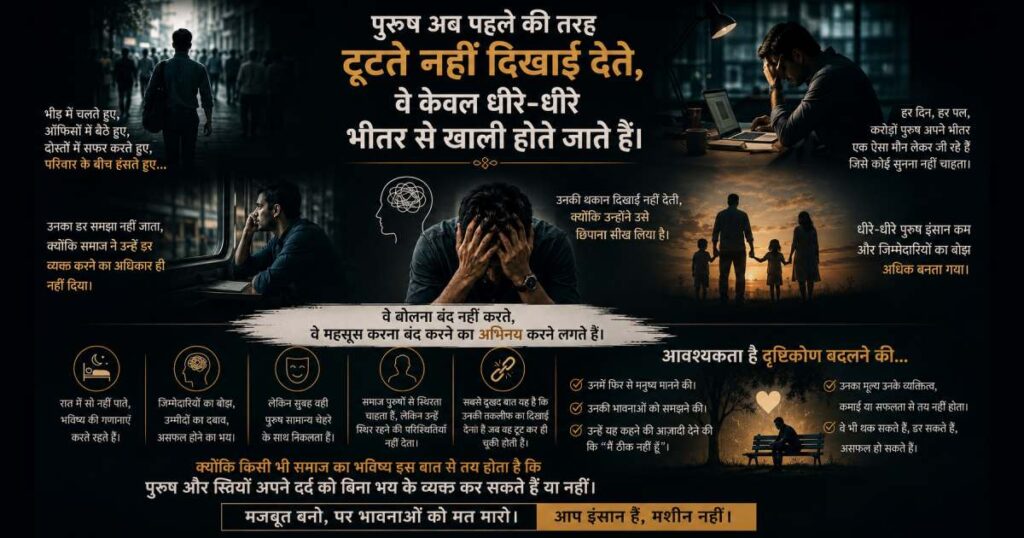
Understanding male silent depression is vital for building an empathetic society because modern men do not break down visibly like before; instead, they slowly become empty from the inside. They no longer weep out loud because they have been strictly conditioned since early childhood that crying is a sign of personal weakness. They never complain because they are repeatedly told that real men do not complain. They completely avoid asking for external help because society has built their entire identity on a fragile illusion that they must look unshakeable strong at all times.
Behind this massive acting performance, millions of men are quietly falling to pieces every single day. They walk through dense crowds, sit in corporate offices, smile during business meetings, and crack jokes among friends. Yet, they carry a continuous internal darkness that absolutely no one can see.
1. The Deep Physical and Soulful Fatigue of Men
A man’s chronic fatigue is never just limited to his physical body. Over time, carrying heavy family responsibilities for years transforms it into a deep fatigue of the soul. Every morning, they do not just go to their jobs; they step out to face the competitive world while hiding their deep fears, inner insecurities, feelings of incompleteness, and past failures right behind a normal face.
The Invisible Cycle of Men's Stress:
Societal Pressures ➔ Hidden Fear of Failure ➔ Absolute Silence ➔ Emotional Burnout
Our society continuously demands final results from men, but it never asks about the severe mental cost they pay. When they earn less money, they face toxic comparisons. When they experience failure, they are mocked. When they show raw emotions, they are labeled as weak. And when they go completely silent, everyone assumes that everything is perfectly fine. This is where the greatest illusion is born. Men are often breaking down the most when they appear completely normal on the outside.
2. Late-Night Anxieties: Understanding Male Silent Depression
A vast majority of men cannot sleep peacefully at night. They stare blankly at the ceiling for hours, calculating complex future equations in their minds. They are constantly haunted by terrifying questions: “What if I suddenly lose my corporate job?”, “What if I fail to meet my family’s high expectations?”, and “What if I am simply not good enough?” The loud noise of these internal questions is so deep that their minds eventually forget how to stay calm.
Yet, the very next morning, that exact man wakes up with a completely normal face. He goes to his workplace, laughs with colleagues, fulfills his duties, and the world assumes he is incredibly strong. But when we invest time in understanding male silent depression, we realize that many men are not actually strong; they are just deeply isolated.

| Societal Conditioning | The Internal Human Reality | The Resulting Coping Mechanism |
| “Men Don’t Cry” | Suppressed sadness turns into heavy grief | Turning into a silent, emotional stone |
| “Always Be the Provider” | Constant fear of financial failure | Chronic insomnia and overthinking at night |
| “Be an Unshakable Wall” | Hidden cracks form in his mental health | Sudden outbursts of anger or complete isolation |
They are never taught during their childhood how to share their internal pain. They are only trained on how to hide it. Slowly, they disconnect from their own feelings. They do not stop feeling pain; they just master the art of hiding it behind an act. Eventually, a time comes when they cannot even remember when they were genuinely happy from the inside. They merely keep playing societal roles – as a son, a husband, a father, a breadwinner, and a structural support system. But throughout this exhausting journey, they are rarely asked, “How are you really doing?”
3. The Broken Walls and Hidden Cracks in Silence
Society proudly views men as protective walls for the family, but it completely forgets that even the strongest walls develop deep cracks over time. They are constantly told to manage the family, secure the future, remain stable, and stay strong. But no one ever asks: who is taking care of the person who is taking care of everyone else? This unsaid, heavy pressure slowly turns men cold and hard.
How Men Mask Internal Sorrow:
Unexpressed Tears ➔ Disguised Anger ➔ Workaholic Patterns ➔ Complete Silent Disappearance
Some men become short-tempered and angry simply because they were never permitted to cry. Others drown themselves completely in endless office work because free time forces them to hear the loud noise inside their minds. Actively practicing understanding male silent depression helps us see why some distance themselves from close relationships – it is because they were never taught the language of emotional expression. And some become so quiet that they completely burn out from inside one day.
To explore clinical research on how emotional isolation affects overall longevity and mental well-being, check out the medical archives on Psychology Today. For global statistics on male mental health support and breaking cultural taboos, read the comprehensive guides on the World Health Organization website.
4. Shifting Perspectives to Humanize Men’s Mental Health
The most tragic part is that society often understands a man’s deep pain only when it is far too late – when his mental balance shatters, when he closes off emotionally, or when he loses his will to live. Men have always been told to be the ultimate solution, which is why they forgot how to express their problems. They were turned into money-earning machines, but were never given the space to remain feeling human beings.
Spreading awareness and understanding male silent depression changes this rigid dynamic. Today, the world does not need men to be more rigid. We need to treat them as humans again. They need to hear that they do not have to be strong all the time, nor do they have to fight every single battle alone. Their human value is never determined solely by their monthly salary, worldly success, or emotional tolerance.
Conclusion: Treating Men as Human Beings First
In conclusion, understanding male silent depression is the first step toward transforming our cultural narrative. A healthy society is not one where men never weep, but one where a man can express his tears without an ounce of shame. Where they are not just handed duties, but also asked about their state of mind. When men live under continuous internal pressure, it isn’t just an individual who breaks – slowly, the emotional balance of the entire society begins to fracture. Right now, the world doesn’t just need new technologies or a better economy; it needs an environment where both men and women can say without fear, “I am looking strong on the outside, but I am entirely exhausted on the inside.”