
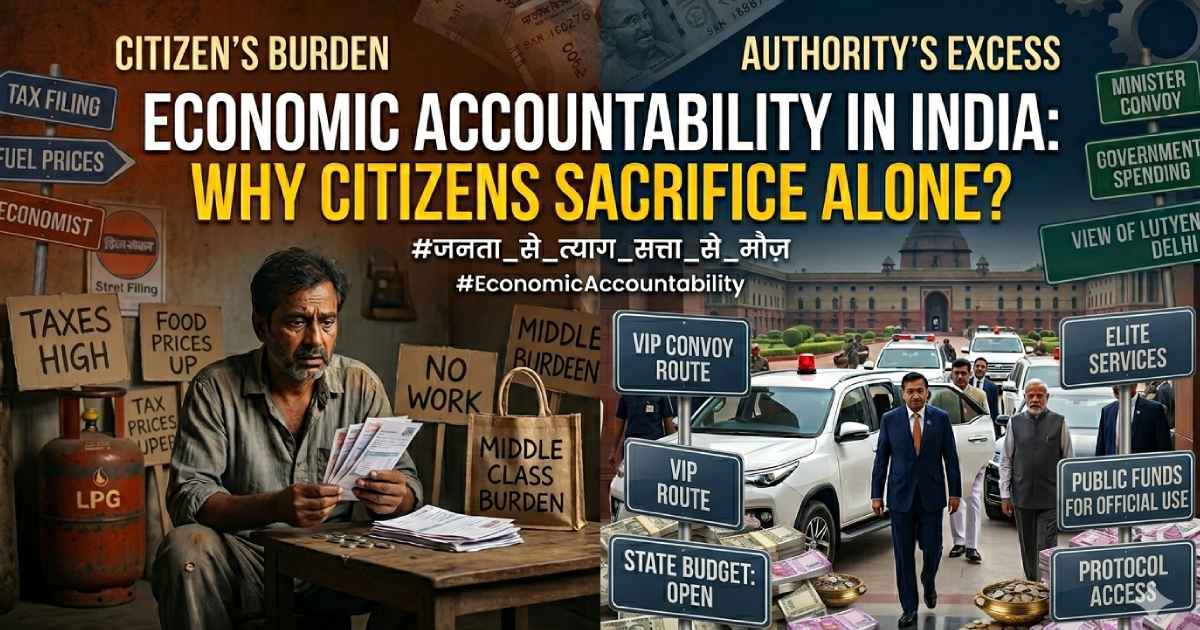
Economic Accountability in India: Why Only Citizens Must Sacrifice?
Economic accountability in India is a topic that surfaces every time the nation faces financial pressure, inflation, or unemployment. Usually, the first response from those in power is to teach the lesson of “sacrifice” to the general public. While this has happened in the past, there was a time when leaders applied these rules to themselves before asking the citizens to follow suit. Today, we are told to use less petrol, travel less, stop buying gold, and cut expenses. But no one explains how long the public must keep cutting their basic needs to prove their patriotism.
The middle class in our country is already buried under the burden of heavy taxes, inflation, unemployment, and expensive healthcare and education. Most people are forced by circumstances to make these cuts just to survive. Economic accountability in India should mean that the burden of a crisis is shared equally, not just placed on the shoulders of the common man.
The Burden on the Poor and Middle Class
A poor man is returning to the traditional clay stove (chulha) because of the high price and unavailability of gas cylinders. Farmers are troubled by the cost of diesel and fertilizers, and the youth are wandering from door to door in search of jobs. Despite these hardships, messages of “more sacrifice” are delivered in the name of national interest.
If national interest is truly supreme, then questions must be asked of the authorities as well. Real economic accountability in India requires answers to these critical points:
- Can government wasteful expenditure not be reduced?
- Can the crores of rupees spent on election campaigning not be cut down?
- Can the relief and loan waivers given to big industrialists not be stopped?
- Can the facilities and perks of MPs and MLAs not be trimmed?
- Will the tax burden on the distressed public remain like this forever?
Nationalism is Not a One-Way Rule
Nationalism should not be a rule meant only for the common citizens. A country does not run solely on the sacrifice of the common man; it runs on the accountability of the government, honest policies, and shared responsibility. Telling the public every time to “eat less, travel less, spend less, and live less” is not a solution.
The real solution is to create a system where every citizen can live with dignity and relief. Patriotism does not mean clapping blindly at every appeal; it also means asking tough questions. In a democracy, the public is not a “devotee” but a responsible citizen and the ultimate owner of the system. Economic accountability in India must start from the top.
| Category | Current Public Struggle | Expected Government Action |
| Energy | High Petrol/Diesel & Gas Prices | Reduction in Fuel Taxes |
| Finance | Heavy Tax Burden on Middle Class | Cutting VIP Perks & Facilities |
| Business | Job Crisis for Youth | Stopping Corporate Loan Waivers |
| Governance | Rising Cost of Living | Reducing Election & Promo Spending |
Questioning the Status Quo
We must move toward a model where “Nationalism” is not used as a cover for administrative failures. When the Reserve Bank of India manages the nation’s wealth, the goal should be the prosperity of the individual household. We need to look at global economic standards where government transparency is a priority.
Today, the condition is such that while the youth are trapped in unemployment and the middle class is crushed by EMIs, the machinery of power continues to run with total luxury. There is no cut in the comfort of those who make the rules. If “walking on foot” is to be called nationalism, then let the ministers leave their convoys first. If “half a stomach” is self-reliance, let it start from the canteens of Parliament.
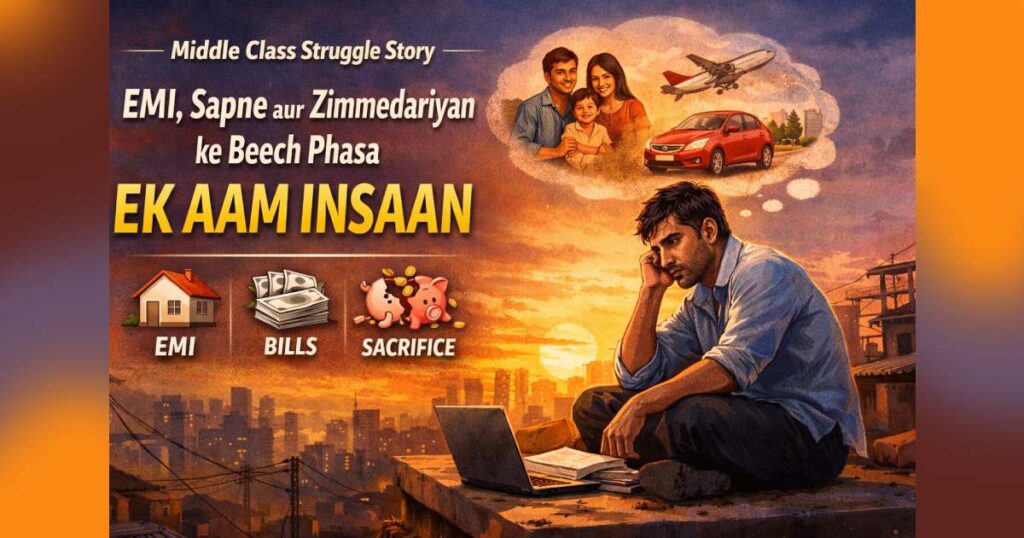
Conclusion: Seeking a Balanced Future
In conclusion, economic accountability in India is about fairness. A strong economy strengthens the pockets of its people; a weak economy teaches the people to sacrifice while the leaders enjoy. We must demand a system where relief is not just a promise on a poster but a reality in our bank accounts and kitchens.
True patriotism lies in building a nation where the government is as responsible as the citizen. Let us move beyond silence and ask for the accountability that we deserve. After all, a democracy survives only when the people in power are as ready to sacrifice as the people who put them there.